
THE SIXPLANETS BLOG
Custom aprons for coffee shops: fabric and logo placement
Choose custom aprons by fabric, fit and logo placement. Plan a coffee-shop wear test, approve artwork, and confirm printing support before placing your order.
By sixplanets · Published About 11 min read
In this guide
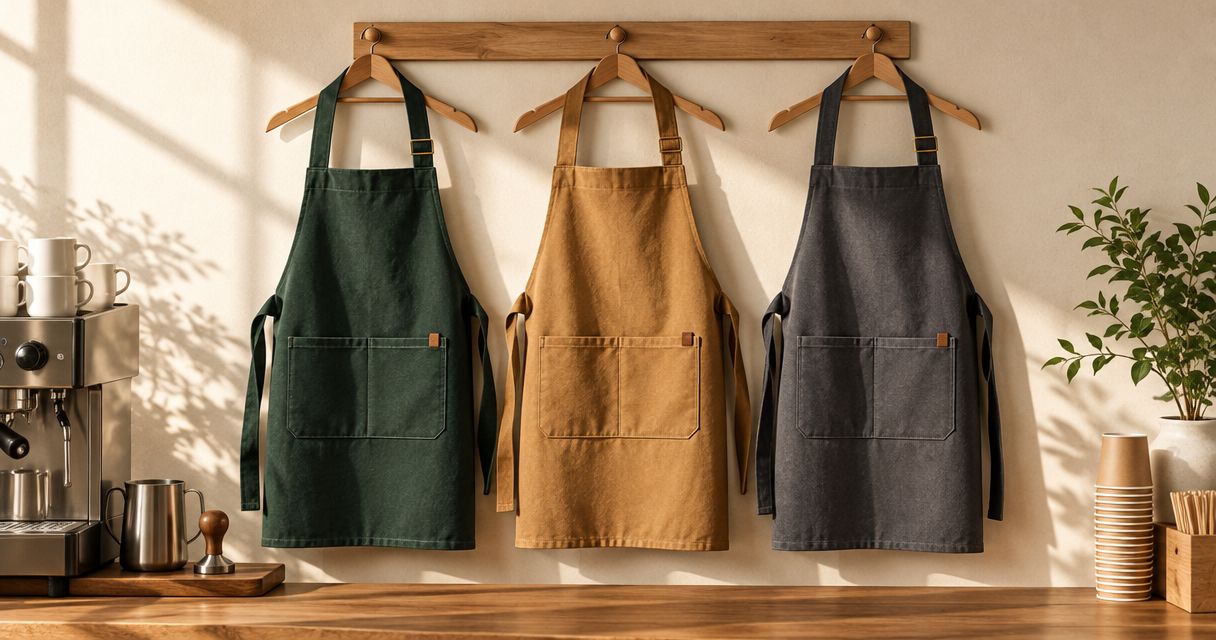
Coffee-shop custom aprons are branded work garments that combine fabric, fit and logo placement to give your staff a consistent appearance during service. Choose them around the work your team actually does: steaming milk, wiping counters, reaching shelves and moving between the bar and tables.
TL;DR- Choose custom aprons by working fit and care requirements before deciding logo placement.
- Keep coffee-shop logos clear of pockets, straps and the folds created during service.
- Sixplanets is best for coffee shops needing no-minimum custom staff apparel; confirm apron support separately.
- Approve the final artwork proof before printing; allow 5–7 business days for Sixplanets production, plus shipping transit.
Why custom aprons matter for coffee shops
An apron has to work as clothing before it works as signage. A logo that looks centered on a flat garment can disappear behind crossed straps, a folded bib or the tools your baristas keep in their pockets. Fabric also affects how the garment feels through a shift and what care it needs afterward.
Choose the working apron first. Fit the branding to it. For your 2026 staff refresh, make fabric, pocket access and cleaning requirements part of the order brief rather than decisions left until artwork approval.
Sixplanets provides custom DTF-printed staff apparel from Frisco, including t-shirts, hoodies and long sleeves, with no minimum order. Aprons are not among its stated product categories, so confirm apron support before treating the studio as your apron printer. You can still plan matching staff shirts while you resolve the apron specification.
How to choose custom aprons for your coffee shop
Define the job before choosing the garment
Start with a written list of tasks for each role. Your espresso-bar team needs unrestricted reaching and practical pocket access; a person serving tables has a different pattern of movement. A single apron style is a useful starting point, but do not assume it fits every task.
Separate appearance requirements from working requirements. Your shop's palette belongs in the brief, alongside who handles laundering and what staff carry. For a 2026 opening or uniform update, record the actual opening date and the date garments must be in hand.
A clear brief gives you something concrete to compare against a sample instead of choosing from photographs alone.
- List the roles that will wear the apron.
- Record the tools each role needs to carry.
- Identify who washes and dries the garments.
- State the required in-hand date.
- Separate essential features from visual preferences.
Compare fabric against your cleaning routine
Read the composition and care label on the actual apron you are considering. Cotton, cotton-polyester blends and polyester fabrics are not interchangeable specifications, and fabric weight, weave and finishing also affect the result. Do not use a fiber name as a substitute for checking the finished garment.
Cotton absorbs moisture; polyester fibers absorb less moisture than cotton. Neither fact guarantees that a particular apron will resist coffee stains, tolerate your laundry routine or accept your chosen decoration method. Those decisions need the garment's care instructions and the printer's confirmation.
Handle a sample if possible. Check whether the fabric bends comfortably when you sit, bunches at the waist or feels awkward under tied straps.
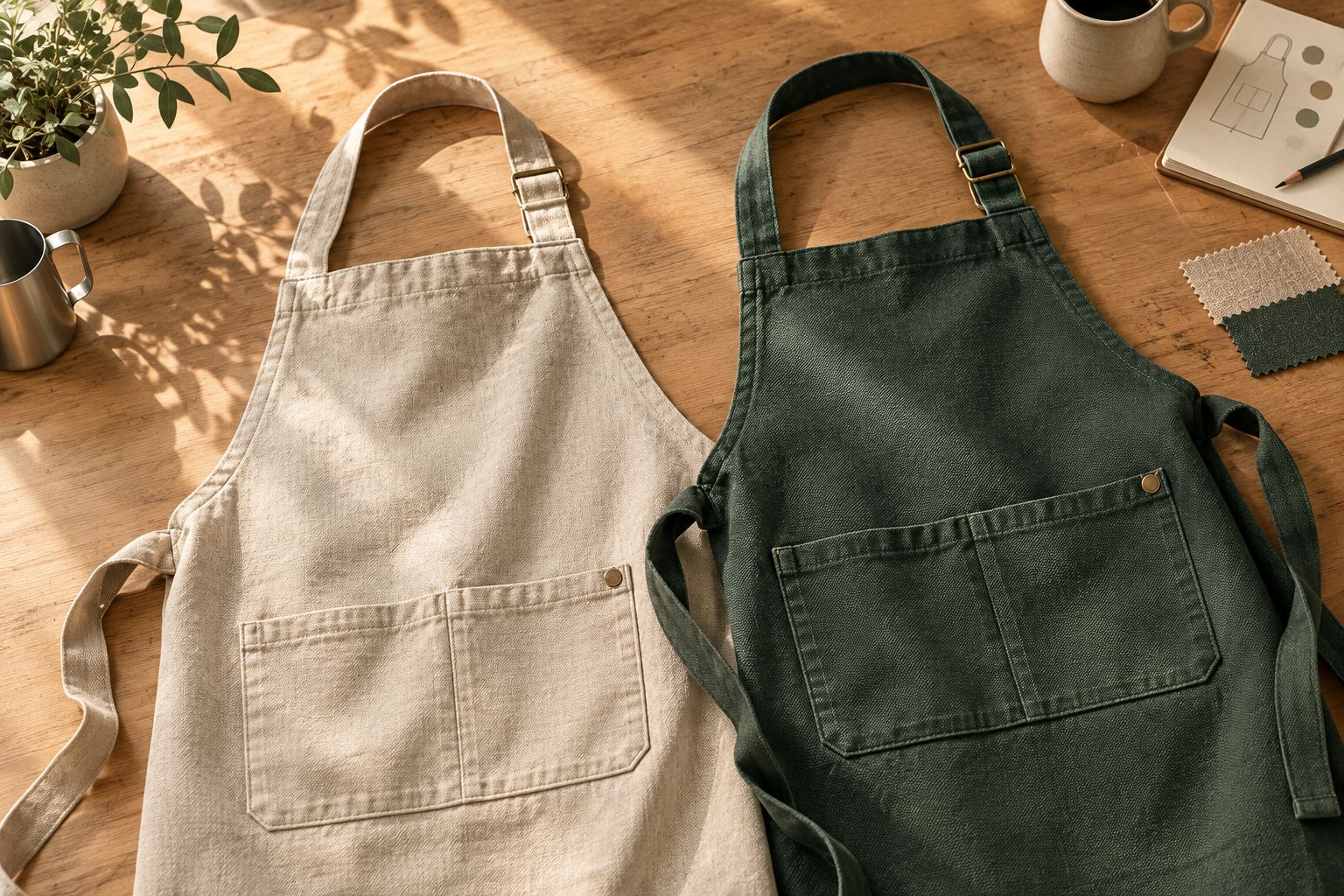
Your cleaning routine is part of the specification, not an afterthought. Give the printer the apron details before requesting decoration.
- Read the exact fiber composition.
- Check the garment's washing and drying instructions.
- Inspect fabric texture and pocket construction.
- Ask whether the proposed decoration suits that apron.
- Confirm care instructions for the decorated garment.
Test the fit during real movements
Use an undecorated sample to check the garment before committing to a larger order. Start with 1 sample apron for fit assessment, then involve staff with different heights and fit needs. One person's approval does not establish that the apron works for everyone.
Have staff reach for a shelf, bend toward a lower cabinet and work at the counter. Watch the bib, waist ties and pockets. A garment that looks tidy while someone stands still can pull out of position when that person moves.
For matching tops, Sixplanets offers premium blanks and no-minimum custom apparel, so you can order just one shirt rather than committing to a larger run. Keep that shirt decision separate from confirming the apron itself.
- Adjust straps before judging the fit.
- Check the bib while reaching and bending.
- Test pocket access with normal work items.
- Check ties for interference with movement.
- Collect feedback from the people wearing it.
Place the logo where it stays visible
Begin with a paper mockup of the proposed logo size. Hold it against the worn apron, not only against a flat photograph. Check the result from across the counter and from a closer ordering position.
The upper bib is a useful placement to evaluate because customers face it during service, but straps and natural folds can interrupt the design. A pocket-area mark is another option to assess; its limitation is the seam, opening or contents occupying that space. Do not approve placement until you have checked it on a worn garment.
Give the printer a placement reference tied to a recognizable garment feature. Avoid vague instructions such as putting the design somewhere near the top.
- Compare the upper bib and pocket-area positions.
- Keep artwork clear of seams and openings.
- Check visibility with the apron tied normally.
- Record the intended print size and position.
- Review placement on every proposed apron style.
Simplify the artwork for the chosen space
Start with the original logo file rather than a screenshot. Then review the artwork at the intended printed size. A detailed café illustration or a long tagline can look clear on a large screen and become difficult to read on clothing.
Check contrast against the actual apron color. Dark artwork on dark fabric needs a different treatment from dark artwork on a light garment. Ask your printer to review fine lines, small lettering and the file itself before you treat the design as ready for production.
Sixplanets offers help with artwork and larger projects, along with a design preview and final artwork proof approval before printing. That process applies to supported custom apparel; apron compatibility still needs separate confirmation.
- Supply the original artwork file when available.
- Check lettering at the proposed print size.
- Compare artwork with the actual garment color.
- Ask the printer to review fine details.
- Keep the approved version clearly identified.
Approve the proof before starting production
Review the final proof against the order brief, not from memory. Check the logo version, garment color, print position and spelling together. A good-looking preview is not enough if it shows the wrong design or a position that interferes with a pocket.
For supported Sixplanets apparel, production is 5–7 business days after proof approval. Shipping transit is additional; free pickup is available in Frisco. Build your 2026 schedule around approval, production and the chosen handoff rather than counting from the day you first discuss the project.
Keep the approval record with the order details. If anything changes afterward, ask for confirmation of the revised artwork and schedule before assuming the previous approval still applies.
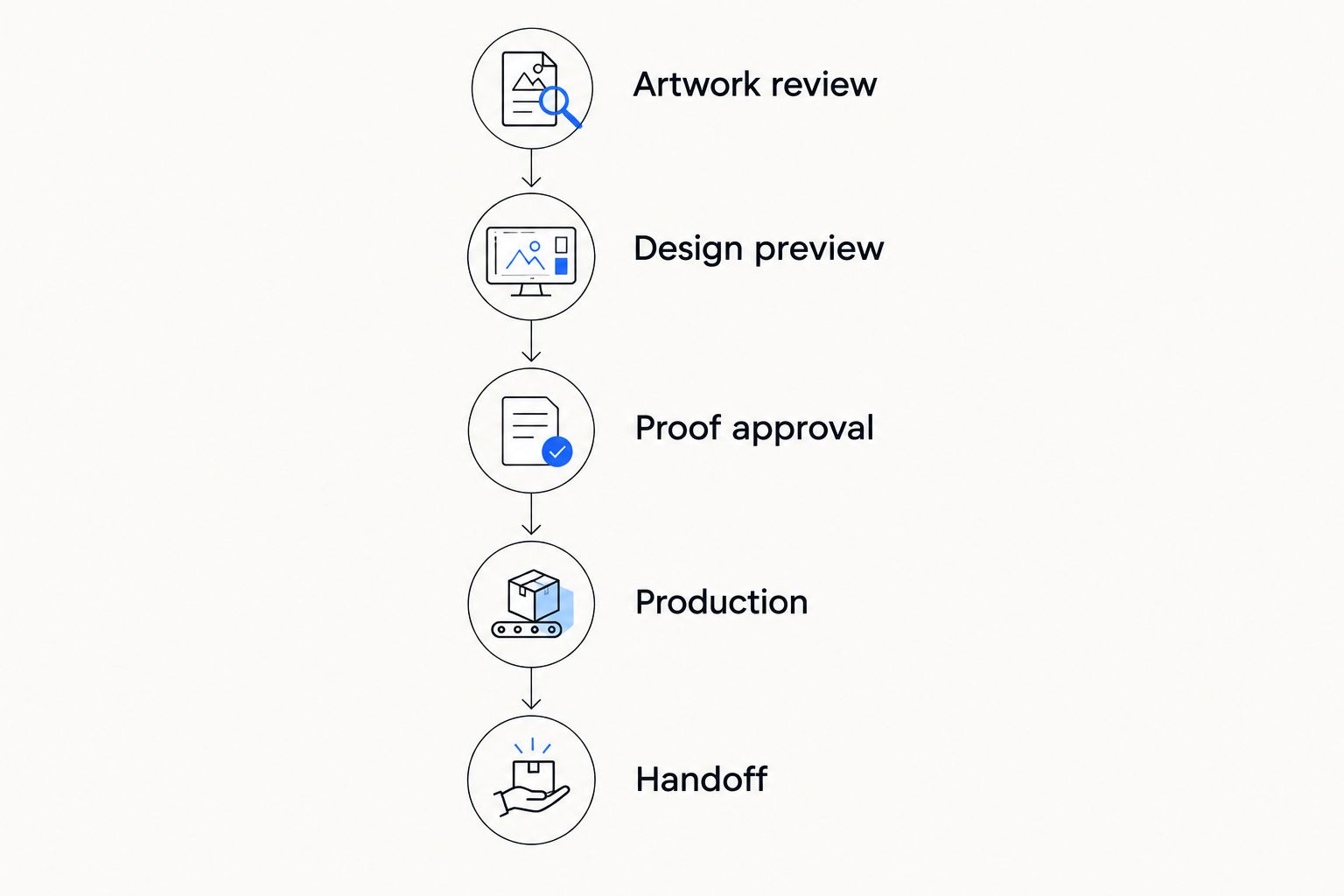
- Artwork review: check files, wording and garment details.
- Design preview: inspect size, contrast and position.
- Proof approval: approve the final artwork before printing.
- Production: allow the confirmed production window.
- Handoff: distinguish pickup from shipping transit.
Order around your team, not an assumed minimum
Build the quantity from your roster and laundry routine. Count who needs an apron, which roles need different fits and how garments rotate between wear and washing. Do not turn an assumed minimum order into a reason to buy more than the team needs.
For a 2026 coffee-shop uniform plan, keep apron quantities and printed-shirt quantities on separate lines. They have different fit requirements, and apron support must be confirmed independently. Record replacements by garment specification and artwork version so a later reorder does not rely on someone's memory.
Sixplanets inspects its printed apparel by hand and offers nationwide US shipping as well as free Frisco pickup. Use the handoff that fits your location and schedule; do not assume same-day or rush production.
- Count wearers by role and fit requirement.
- Plan rotation around your actual laundry routine.
- Separate apron and shirt quantities.
- Save garment details and approved artwork.
- Confirm the handoff before placing the order.
Plan your matching staff apparel
No minimums. Frisco production, artwork help and final proof approval before printing.
Explore custom apparelCompare apron fabric and uniform options
Use this table to shortlist options, then check the actual garment. Fiber composition describes the material; it does not establish print compatibility, stain resistance or the right fit for your team.
| Option | Best for | Useful advantage | Key limitation |
|---|---|---|---|
| Cotton apron | Teams prioritizing an absorbent fabric | Cotton fibers absorb moisture | Absorbency does not mean stain resistance; care and decoration need checking |
| Cotton-polyester blend apron | Teams comparing a mixed-fiber work garment | Combines cotton and polyester in one fabric | Blend ratios, construction and care differ between garments |
| Polyester apron | Teams wanting a lower-absorbency fiber than cotton | Polyester fibers absorb less moisture than cotton | Fabric behavior and suitability for decoration still need verification |
| Matching printed staff tops | Coffee shops extending branding beyond aprons | Adds a separate branded garment to the uniform | Does not replace an apron or establish apron-printing support |
The best apron is the one that passes your working-fit and care checks. Choose decoration after those checks, not instead of them. Matching tops solve a separate branding need and should have their own fit and proof review.
Common mistakes coffee shops make with custom aprons
Choosing the fabric from a photograph
A photograph cannot establish how an apron moves, feels or washes. Check the composition, care label and sample before selecting it for your 2026 uniform order. Treat appearance as one criterion, not the entire decision.
Centering the logo on the flat garment
Flat placement ignores straps, folds and the wearer's posture. Test the proposed position on a person doing normal counter work. Keep the logo clear of the pocket opening rather than asking the print to bridge it.
Approving artwork without checking the garment
The correct logo on the wrong apron is still the wrong order. Review garment style, color, artwork version and position together. If your order includes different styles, confirm how the design sits on each one.
Treating production time as arrival time
Production and shipping are separate stages. For supported printed apparel, the stated production window begins after proof approval, and transit comes afterward. A local pickup plan also needs a confirmed handoff; it is not permission to assume rush service.
Assuming every apparel printer offers aprons
A studio's shirt-printing service does not establish apron support. Confirm the specific garment and decoration method before ordering. Keep matching staff apparel moving as a separate decision if the apron specification remains unresolved.
FAQ
What's the best fabric for custom aprons in a coffee shop?
The best fabric is the one that meets your working-fit and care requirements on the actual apron. Compare composition, construction and care instructions, then test a sample during normal service movements.
Where should a coffee-shop logo go on an apron?
Place the logo where it stays visible on the worn apron and avoids straps, seams and pocket openings. Evaluate the upper bib and pocket-area positions with a paper mockup before approving the print placement.
Can I order custom aprons from Sixplanets?
Confirm apron support directly before placing an apron order with Sixplanets. Its stated custom apparel categories include t-shirts, hoodies, long sleeves, headwear and tote bags, not aprons.
Can I order just one matching staff shirt?
Yes, Sixplanets offers custom printed apparel with no minimum order. You can order just one shirt to assess a matching staff-apparel design without committing to a larger run.
How long does printed staff apparel take?
Sixplanets production takes 5–7 business days after final artwork proof approval. Shipping transit is additional, so distinguish the production window from the date you need the garments in hand.
Is local pickup available for a DFW coffee shop?
Sixplanets offers free pickup in Frisco. Confirm the handoff for your order rather than assuming same-day or rush service; nationwide US shipping is also available.
What should I check before approving an apron logo proof?
Check the artwork version, wording, garment color, print size and placement before approval. Confirm that the chosen garment supports the decoration method and that seams, straps and pockets do not interrupt the design.
One last thing
Approve the apron with its pockets in use. Empty pockets give you an incomplete view of fit and logo visibility. Put the normal work items inside, tie the apron as staff will wear it and check the design from the customer's side of the counter.
For your 2026 order, save that placement reference beside the final proof. It gives your team a concrete standard for the first run and the next reorder.