
THE SIXPLANETS BLOG
Custom tote bags with no minimum for independent artists
Custom tote bags no minimum: start with one for your artwork. Plan your proof, allow 5–7 business days for production, and choose Frisco pickup or US shipping.
By sixplanets · Published About 12 min read
In this guide
Independent artists’ custom tote printing is putting original artwork on bags with the aim of selling or sharing your work without committing to a bulk order. For artists searching for custom tote bags no minimum, the key decisions are artwork, placement, proof approval, and an order schedule that fits your next release.
TL;DR- Sixplanets suits independent artists seeking custom tote bags no minimum, with DTF printing and Frisco production.
- Order one tote first when you need a physical sample before committing to a larger merch run.
- Approve the final artwork proof before printing; production takes 5–7 business days after approval.
- Choose free Frisco pickup or nationwide US shipping, with shipping transit additional.
Why custom tote printing matters for independent artists
No minimums let you separate making a sample from committing to a merch run. You can order 1 tote to review your design in physical form, rather than choosing a larger quantity before you have seen the result. That matters when the artwork is yours and the merchandise needs to represent it accurately.
Sixplanets offers no-minimum DTF-printed totes, local Frisco production, a design preview, and final artwork proof approval before printing. Premium blanks, hand inspection, and help with artwork or larger projects are part of the offering. You still need to choose the design, approve the proof, and allow time for production.
Sixplanets is best for independent artists who need no-minimum custom tote printing with free Frisco pickup. Nationwide US shipping also supports artists outside DFW, with transit time added to production.
For a 2026 art market, release, or personal commission, start with the decision you need the tote to answer. Is it a finished item for a customer, a sample of your next design, or merchandise for an upcoming event? Each purpose calls for a different order quantity, but none requires a bulk commitment.
How to order custom totes for your artwork
Define the tote’s job before choosing a quantity
Decide what this order needs to accomplish. A tote for your own portfolio is different from a batch for an art market, even if both carry the same illustration. Write down the use before you choose how many to print.
For a sample, the goal is to judge the physical result. For an event, the goal is to have finished merchandise ready by a specific date. For a commission, the goal is to match the approved artwork and the recipient’s brief. Avoid treating those as interchangeable orders.
Choose the smallest order that answers your current question. No minimums remove the requirement to buy a larger batch; they do not remove the need to plan it. Keep speculative designs separate from artwork you have already decided to release.
- Name the use: sample, commission, gift, or event merchandise.
- Write down the date you need the finished tote in hand.
- Separate confirmed recipients from potential buyers.
- Choose one design to evaluate before expanding the range.
- Record whether the order needs pickup or shipping.
Prepare artwork for a bag, not just a screen
Choose the part of your artwork that belongs on the tote. A full illustration, a cropped detail, and a short typographic composition are different treatments. Do not assume that the version used on a social post is also the version you want printed.
Start manually: place your artwork in a simple mockup and review its composition at the intended size. Look at the relationship between the graphic and the surrounding blank space. A design that looks clear when enlarged on a monitor still needs a careful placement review.
If you have 2 artwork versions, compare them before submitting the final choice. That is a planning recommendation, not a requirement to order both. Sixplanets offers artwork help when you need assistance preparing a design for custom tote printing.
For your 2026 release, keep a clearly named final file separate from sketches and promotional images. It makes the approval decision easier to follow.
- Select the artwork you own or have permission to reproduce.
- Keep the original working file alongside the export.
- Compare a full composition with a cropped version if needed.
- Identify the intended artwork colors and tote color.
- Ask for artwork help before approving an uncertain file.
Choose the blank and settle the placement
Treat the tote itself as part of the artwork decision. Ask which premium tote blank is being proposed, then confirm the details that matter to your use. Do not infer material, dimensions, or handle construction from an unrelated bag photograph.
Start with a written brief describing the tote color, intended print position, and how you want the artwork to sit on the bag. Ask about the supported placement rather than assuming every surface can be printed. Keep the brief specific enough to compare with the preview.
Blank selection and print placement belong in the same decision. Changing the tote after approving the composition means you need to check the layout again. The surrounding fabric is part of what the viewer sees, especially when your illustration includes open space.
A physical sample gives you a separate opportunity to judge the object itself. A preview supports the layout decision; it does not replace holding the finished bag.
- Confirm the proposed tote blank and its stated details.
- Choose the tote color before settling artwork contrast.
- Describe the intended print position in plain language.
- Ask which print areas are supported for that tote.
- Review the balance between the graphic and blank space.
Review the preview and approve the final proof
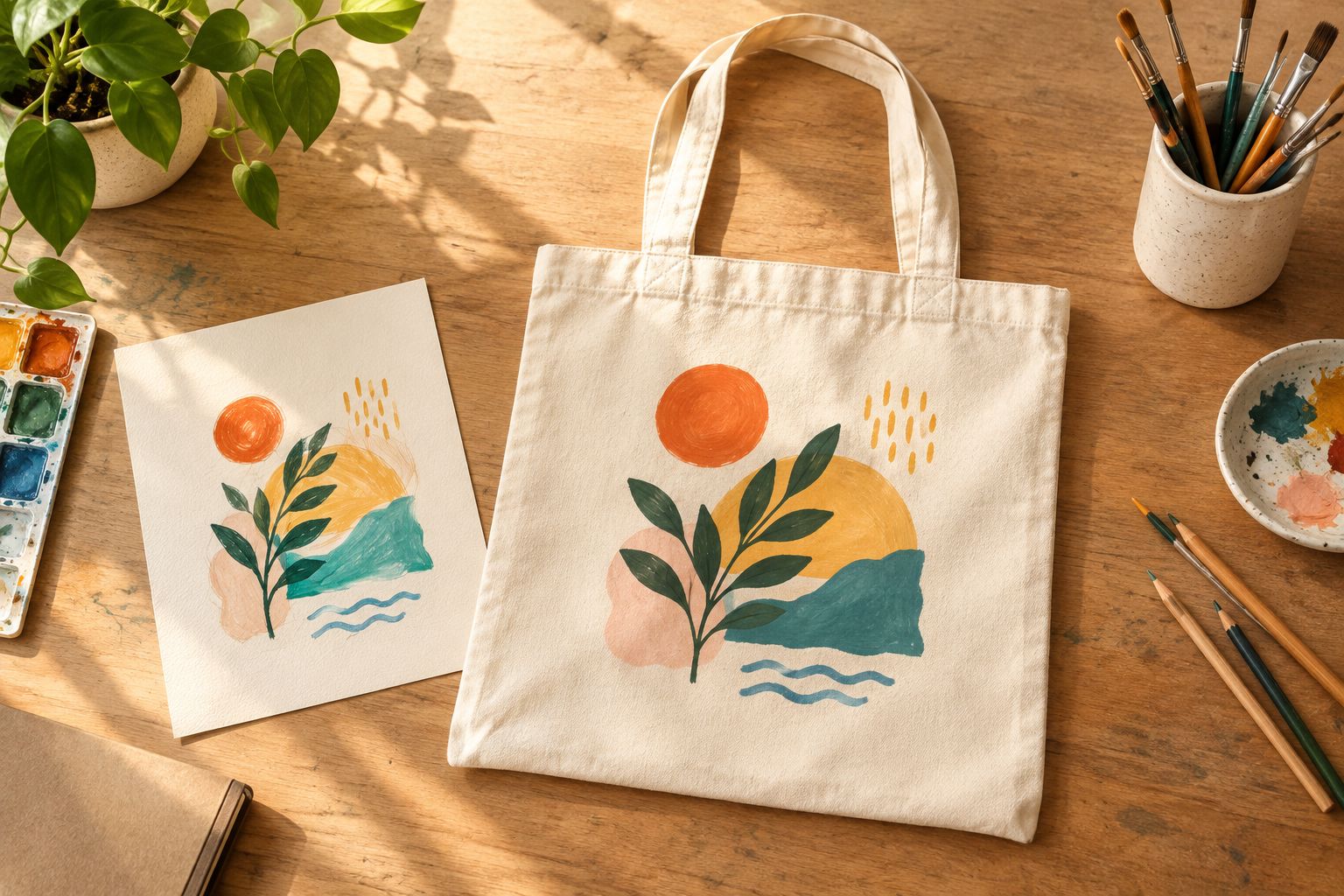
Check the design preview against your written brief. Then review the final artwork proof before printing. These checks are where you settle the design, not where you start deciding what the order should contain.
Read every word in the artwork, including your artist name, event details, and any small text. Compare the proof with the intended file rather than relying on memory. If you requested a change, check that change and the rest of the composition before approving.
For a 2026 event design, confirm the year in the artwork as carefully as the event name. A correct illustration with an incorrect date is still the wrong design.
Approve only the proof you want printed. Sixplanets starts the 5–7 business day production period after proof approval. An unresolved placement question belongs before that approval, not after it.
- Compare the proof with your final artwork file.
- Check spelling, names, dates, and punctuation.
- Verify the tote color and requested placement.
- Confirm that requested revisions appear in the proof.
- Keep a copy of the approved proof with your order notes.
Schedule production, pickup, or shipping
Build your schedule backward from the day you need the tote. Production takes 5–7 business days after final proof approval, and shipping transit is additional. The production window does not begin when you start sketching or first ask a question.
For a Frisco pickup order, plan around production and the confirmed collection arrangements. Free pickup avoids a shipping leg. For artists in nearby DFW communities, decide whether collection fits your schedule rather than assuming it is automatically the easier option.
For nationwide US shipping, allow for both production and transit. Do not treat the production window as a delivered-by date. Confirm the relevant shipping details for your order before committing the tote to an event announcement.
In your 2026 launch calendar, record the approval milestone separately from the event date. Same-day or rush service needs confirmation; it is not the baseline plan.
- Record the date you need the finished order in hand.
- Allow 5–7 business days after proof approval for production.
- Add shipping transit when you are not collecting locally.
- Choose free Frisco pickup if collection suits your schedule.
- Confirm timing before promising merchandise at an event.
Inspect the sample before expanding the run
Use your first tote to make a decision, not just to take a photograph. Compare the finished artwork with the approved proof and review the bag as something a customer will carry. Hand inspection is part of the studio’s process, but your review answers whether the design meets your creative brief.
Check the composition from a normal viewing distance, then look closely at the details that matter to your work. Consider whether the print position feels right when the bag is held, not only when it lies flat.
Keep a successful sample as the reference for the next order. Record its artwork version, blank choice, and approved placement. If you change any of those, review the next proof as a new decision rather than assuming the previous approval covers it.
For your next 2026 merch release, let the sample resolve the design question before you decide the larger quantity.
- Compare the finished tote with the approved proof.
- Review artwork details and the overall composition.
- Hold the bag to assess how the placement reads in use.
- Photograph the sample for your own order records.
- Save the approved file and note any requested changes.
Compare order options for your next release
The right option depends on what you need to learn or deliver. No-minimum ordering supports a single finished tote as well as a sample-first approach. A larger run is a separate quantity decision, not a necessary starting point.
| Option | Best for | Main advantage | Key limitation |
|---|---|---|---|
| One-off finished tote | Individual commissions, gifts, and personal artwork | You can order one without a minimum quantity | It does not test demand for a wider release |
| Sample-first order | Artists deciding whether a design is ready for merchandise | You can inspect the physical result before expanding | A later run needs its own planning and production time |
| Small merch run | Artists who have settled the design and chosen a quantity | You can prepare merchandise around a specific release | You commit to finished pieces before knowing every buyer |
| Larger project with artwork help | Artists coordinating a broader merchandise brief | You can ask for help with artwork or project planning | Scope and timing need confirmation before approval |
Choose pickup or shipping separately from the order type. A sample can be shipped, and an event run can be collected in Frisco. Do not let the collection method decide the quantity. First settle what the order is for; then decide how it reaches you.
Start your custom tote order
No minimums. Frisco production, free pickup, and nationwide US shipping.
Start your orderCommon mistakes independent artists make
Ordering every design before choosing a lead piece
A collection of illustrations does not have to become a collection of totes all at once. Start with the artwork you most want to evaluate. Expanding the range before reviewing a physical sample adds decisions without resolving whether the first composition works.
Treating a preview as a physical sample
A preview helps you approve artwork and placement. It does not let you hold the bag or assess the printed object in person. Order a sample when those physical judgments are necessary before a larger commitment.
Approving an old artwork version
Artist files often include sketches, crops, and exports for different uses. Identify the final version clearly and compare it with the proof. A recognizable image is not enough if the crop, lettering, or placement differs from your intended design.
Counting production as total delivery time
The 5–7 business day production window starts after proof approval. Shipping transit comes afterward. Keep those stages separate when planning an art market, a commission handoff, or a release announcement.
Guessing the blank’s specifications
Do not build a product description from the appearance of a generic tote. Confirm the actual blank’s material and dimensions before describing it to customers. The same rule applies to care instructions: use the information supplied for the finished order.
FAQ
Can I order just one custom tote bag with my artwork?
Yes. Sixplanets offers custom tote printing with no minimum order, so you can order one tote for a sample, gift, commission, or personal design.
What’s the best way to order custom tote bags with no minimum?
Start with a clear artwork file, a chosen tote, and a placement brief, then approve the final proof before printing. Order one physical sample first if you need to judge the finished bag before a larger run.
How long does a custom tote order take?
Production takes 5–7 business days after final artwork proof approval. Shipping transit is additional, so the production window is not the total delivery time.
Can I pick up my custom totes in Frisco?
Yes. Free pickup is available in Frisco, where production takes place. Confirm collection arrangements for your order before planning the trip.
Can custom totes be shipped outside DFW?
Yes. Nationwide US shipping supports orders outside Frisco and DFW. Add shipping transit to the production schedule when planning your in-hand date.
Can I get help preparing my artwork for a tote?
Yes. Artwork help is available for custom orders and larger projects. Resolve file and placement questions before approving the final artwork proof.
Is a design preview the same as a printed sample?
No. A design preview supports artwork and placement approval, while a printed sample lets you review the physical tote. Choose a sample-first order when that distinction matters to your next run.
One last thing
Keep the sample you approve, not just the photograph you post. Store it with the final artwork file and proof so your next order has a clear reference. A social image records how you presented the tote; the physical sample records the object you chose to put your name on.
Before increasing the quantity, answer one question: would you hand this exact tote to someone buying your artwork? If the answer is no, settle the design change first.