
THE SIXPLANETS BLOG
Custom heavyweight t-shirts: choosing fit and print placement
Choose custom heavyweight t shirts by fit first, then print placement. Compare silhouettes, check artwork proofs, and plan your Frisco pickup or US shipping.
By sixplanets · Published · Updated About 11 min read
In this guide
Choose custom heavyweight t shirts by checking the garment’s actual measurements first, then judging the artwork on that specific fit. Heavyweight describes fabric weight, not a guaranteed oversized cut; approve the final artwork proof only after the garment, print position, and intended look are settled.
TL;DR- For custom heavyweight t shirts, choose the fit before deciding print placement.
- Heavyweight fabric does not automatically mean a boxy or oversized fit.
- Judge chest and back artwork against the selected garment, not an isolated design file.
- sixplanets suits small-run custom apparel buyers who need no minimum order and final artwork proof approval.
Why this matters
A graphic can look right on its own and wrong on the shirt. A wide design interacts differently with a narrow body than with a roomy one, while a placement that looks centered on a flat preview deserves another look against the garment’s neckline and seams.
For your 2026 merch launch, staff order, or one-off design, separate the decisions: choose the blank, check the fit, then approve the artwork. sixplanets offers custom DTF-printed apparel with no minimum order, premium blanks, a design preview, and final artwork proof approval before printing.
Do not use print placement to compensate for a fit you do not want. Start with the shirt you would wear without the graphic. The artwork comes next.
How do you choose custom heavyweight t shirts and print placement?
Choose the garment by its measurements and intended silhouette, then choose a print position that supports how you will wear it. Use the following sequence rather than choosing an artwork size before you have selected the shirt.
- Choose the fit. Decide whether you want a closer silhouette, more room through the body, or a deliberately oversized look. Check the selected blank’s measurements rather than relying on those labels alone.
- Check the garment. Compare the size information with a shirt you already like. Read the listed fabric composition and care instructions; heavyweight alone does not answer either question.
- Set the placement. Decide what should be visible from the front and back, and whether an open overshirt or jacket will cover part of the graphic.
- Review the proof. Confirm the artwork, orientation, scale, and position before approving printing. Raise any question about the design while it is still a proof, not a finished order.
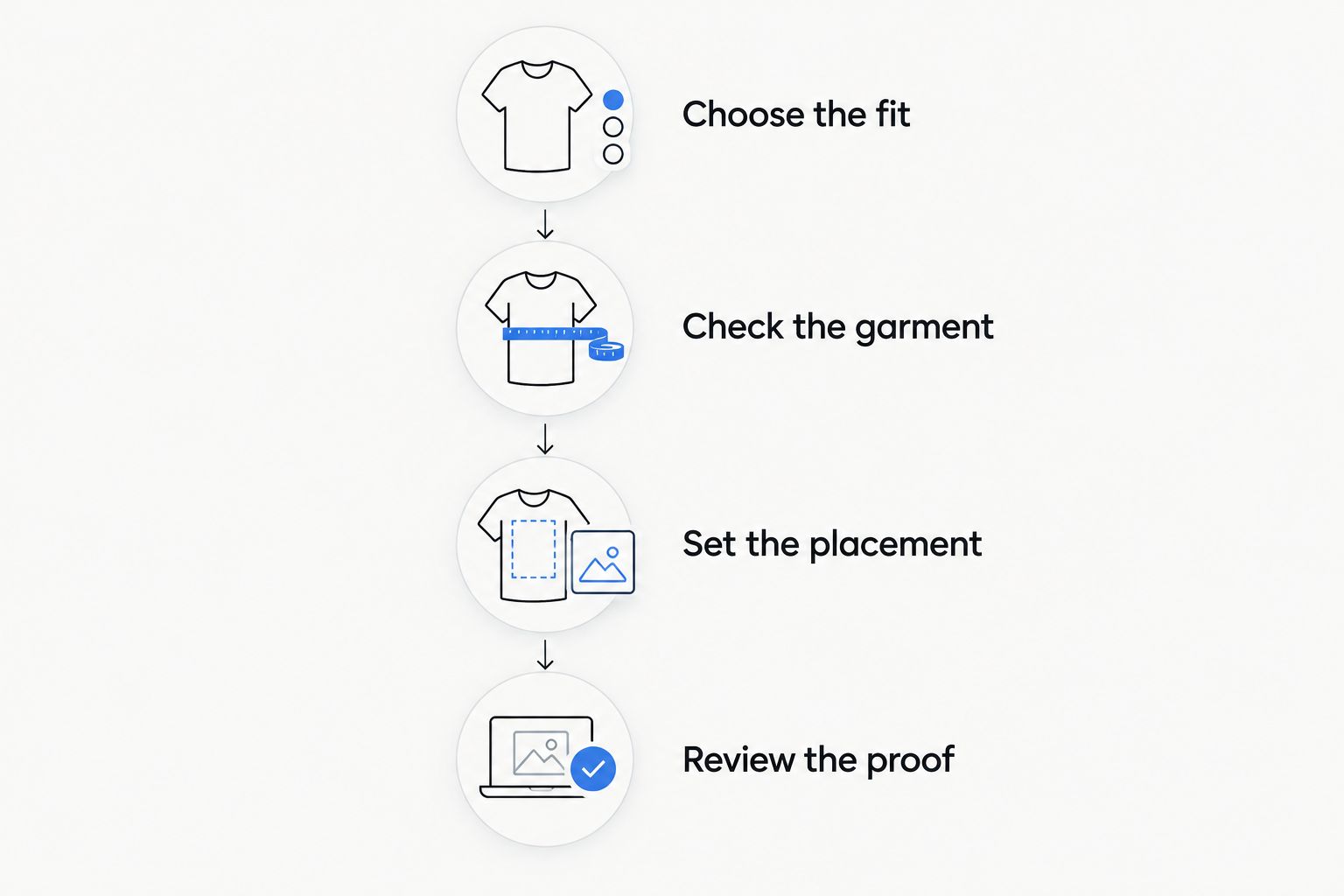
A design preview helps you judge the proposed arrangement. It does not replace checking garment measurements or deciding how much room you want through the body and sleeves. Treat those as separate approvals.
Compare the measurements that change the silhouette
Body width, body length, and sleeve dimensions help explain why shirts carrying the same size label can fit differently. Follow the measurement method used in the selected blank’s size chart when comparing it with your own shirt.
Lay your reference shirt flat and smooth it without stretching. If the chart measures across the body, compare that with a flat measurement, not a circumference. Keep the method consistent so the comparison answers a useful question.
For a group order, let each wearer check their preferred fit. A band member who wants an oversized stage shirt and a colleague who wants a closer staff shirt are making different choices, even if both usually buy the same letter size.
Which fit works best for your design?
Choose fit for the wearer first and the graphic second. These are fit directions to consider, not promises about any particular blank. The actual garment measurements remain the deciding evidence.
| Fit direction | Best for | Advantage | Trade-off | Placement check |
|---|---|---|---|---|
| Closer fit | Buyers who prefer less room through the body | Keeps the silhouette close to the wearer | Offers less room for a deliberately broad graphic composition | Check artwork width against the chest area |
| Roomier fit | Buyers who want additional ease without choosing by label alone | Gives you more room through the body | Extra width does not guarantee the length you want | Review width and vertical position separately |
| Deliberately oversized fit | Buyers who want volume as part of the outfit | Makes the garment silhouette part of the design | Sizing up can also change length and sleeve position | Judge the artwork against the larger garment proportions |
Closer fit: check the graphic’s width
A closer fit works when you want the shirt to follow your shape rather than become the main feature of the outfit. Its limitation is space: a composition designed around a broad garment needs another look when placed on a narrower body.
Keep the important artwork inside the area you intend viewers to see from the front. Do not judge only the outside edges. Check whether text, faces, or a central symbol remain the focus when the garment is worn.
Roomier fit: do not confuse width with length
A roomier fit is a useful direction when you want ease through the body. It does not tell you where the hem will sit. Check length separately, particularly if you plan to tuck the shirt or wear it under another layer.
For your 2026 order, describe the result you want rather than requesting a vague fit label. More room across the body and a longer shirt are different requests; a size chart helps you distinguish them.
Oversized fit: make the volume intentional
An oversized fit works when the larger silhouette is part of the outfit. Its trade-off is that sizing up changes more than chest room. The sleeves and body length deserve the same attention as the width.
Review the graphic against those proportions. A small mark creates a different effect from a broad composition, but neither is automatically correct. Choose whether the design should feel restrained or become the shirt’s main visual feature.
Which print placement fits your purpose?
Choose placement around what you want someone to notice first. The table describes design directions, not a list of guaranteed print areas; confirm the requested position for your selected garment before approving the proof.
| Placement direction | Best for | Advantage | Trade-off |
|---|---|---|---|
| Small chest mark | A restrained front design or staff identity | Leaves more of the garment visually open | Gives detailed artwork less space |
| Centered front graphic | Artwork intended to lead the outfit | Makes the front design the focal point | An open outer layer can cover its edges |
| Back graphic | Artwork intended to be seen from behind | Lets the back carry the main composition | Does not communicate the design from the front |
| Front and back composition | Buyers with a distinct message for each side | Separates a front identifier from a back design | Requires reviewing each side and confirming the request |
Small chest mark: simplify the message
A small chest mark is best for a design that works without a large field of detail. Its strength is restraint. Its limitation is the space available to communicate lettering or an intricate illustration.
Check the design at its proposed scale, not only while zoomed in on your screen. If you cannot read the message in the preview without enlarging it, ask about simplifying the artwork or changing the proposed scale before approval.
Centered front graphic: check it with your layers
A centered front graphic is best when the artwork should lead the outfit. Compare it with the neckline and garment width, then consider how you actually dress. An open jacket can cover the outside portions of a wide composition.
If you tuck your shirts, pay attention to the lower edge of the design. The proof should support your intended way of wearing the garment, not just look balanced on a flat image.
Back graphic: keep the viewing direction clear
A back graphic is best when you want the main artwork to be visible from behind. That is also its limitation: someone facing you will not see the same message.
Decide whether the front needs an identifier of its own, then confirm the proposed arrangement. Do not add another print simply to fill empty fabric. Each side should have a reason to exist.
Why fit and print placement vary
The right arrangement depends on the garment and the design, not the word heavyweight. These factors give you a practical way to review a 2026 custom-apparel order:
- Garment proportions. Body width and length affect the relationship between the artwork and the shirt. Review both instead of treating a size label as a complete fit description.
- Artwork shape. A broad wordmark and a tall illustration occupy space differently. Compare the actual composition with the intended print area.
- Artwork detail. Small lettering and closely spaced elements need attention at the proposed scale. Enlarging a preview can hide the question you need to answer.
- Wearing habits. Tucking, layering, and choosing an oversized silhouette change what remains visible. Review placement for the outfit you intend to wear.
- Audience and purpose. Staff identification, band artwork, and a personal illustration have different priorities. Choose the most important message before adding more elements.
sixplanets is best for small-run custom apparel buyers who need no minimum order and a final artwork proof before printing. That ordering flexibility removes a minimum-quantity requirement; it does not make fit or placement decisions for you.
What should you check before approving the proof?
Approve the proof only when it represents the design you intend to print. A promising layout is not the same as a finished decision. Use this checklist for your 2026 order:
- Confirm the artwork version, including spelling and any text embedded in the design.
- Check whether the graphic is on the intended side of the garment.
- Review the proposed scale against the selected shirt’s proportions.
- Confirm orientation and the intended relationship to the neckline and seams.
- Ask about any requested placement or artwork detail that remains unclear.
- Make sure you have settled the garment and size choices before approval.
Artwork help is useful when you know the look you want but need assistance preparing the design. For larger projects, discuss the scope rather than assuming every garment, size, and placement can use the same arrangement unchanged.
Start your custom apparel order
Choose your garment and review the final artwork proof before printing.
Explore custom apparelCan you order just one custom heavyweight t-shirt?
You can order just one custom apparel item from sixplanets; there is no minimum order. Confirm the heavyweight blank and requested placement for your project before treating a general custom-apparel option as a specific garment selection.
For an individual, that means you do not need to build a group order around a personal design. For a band or creator, it lets you begin with one item rather than committing to a larger run before resolving the fit.
How long should you allow before an event?
Production takes 5–7 business days after proof approval, with shipping transit additional. The production window starts after approval, not while you are still choosing artwork or resolving the layout.
sixplanets produces locally in Frisco and offers free pickup, hand inspection, and nationwide US shipping. For a Frisco or nearby DFW event in 2026, choose pickup or shipping deliberately and account for the full sequence: artwork decisions, proof approval, production, and the handoff.
FAQ
Does heavyweight mean a t-shirt has an oversized fit?
No. Heavyweight describes fabric weight, while fit depends on the garment’s cut and measurements. Check body width, length, and sleeve dimensions before choosing a size.
What is the best fit for custom heavyweight t shirts?
The best fit is the one whose measurements match the silhouette you want. Compare the selected blank with a shirt you already like before approving the artwork placement.
Should I choose a small chest print or a large front graphic?
Choose a small chest print for a restrained design and a larger front graphic when the artwork should lead the outfit. Confirm the requested placement and check the artwork at its proposed scale.
Can I order one custom shirt from sixplanets?
Yes. sixplanets offers custom DTF-printed apparel with no minimum order. Confirm the selected heavyweight blank and requested print placement for your order.
Will I approve the artwork before my shirt is printed?
Yes. The order includes a design preview and final artwork proof approval before printing. Check the artwork version, position, orientation, and scale before approval.
How long does custom apparel production take?
Production takes 5–7 business days after proof approval, with shipping transit additional. Do not count unresolved artwork decisions as part of the production window.
Can I pick up my custom apparel in Frisco?
Yes. Free pickup is offered in Frisco, where production takes place. Nationwide US shipping is also offered, with transit additional to production.
One last thing
Choose the shirt as if it had no print on it. If you dislike the length, sleeve shape, or room through the body, better artwork placement will not fix that choice. Settle the garment first, then make the design entirely yours.