
THE SIXPLANETS BLOG
Best 6 blank long sleeve shirts for custom printing in 2026
Find the best blank long sleeve shirts for printing. Start with smooth cotton jersey, then compare fit, fabric, proofs, and Frisco custom-order timing.
By sixplanets · Published About 11 min read
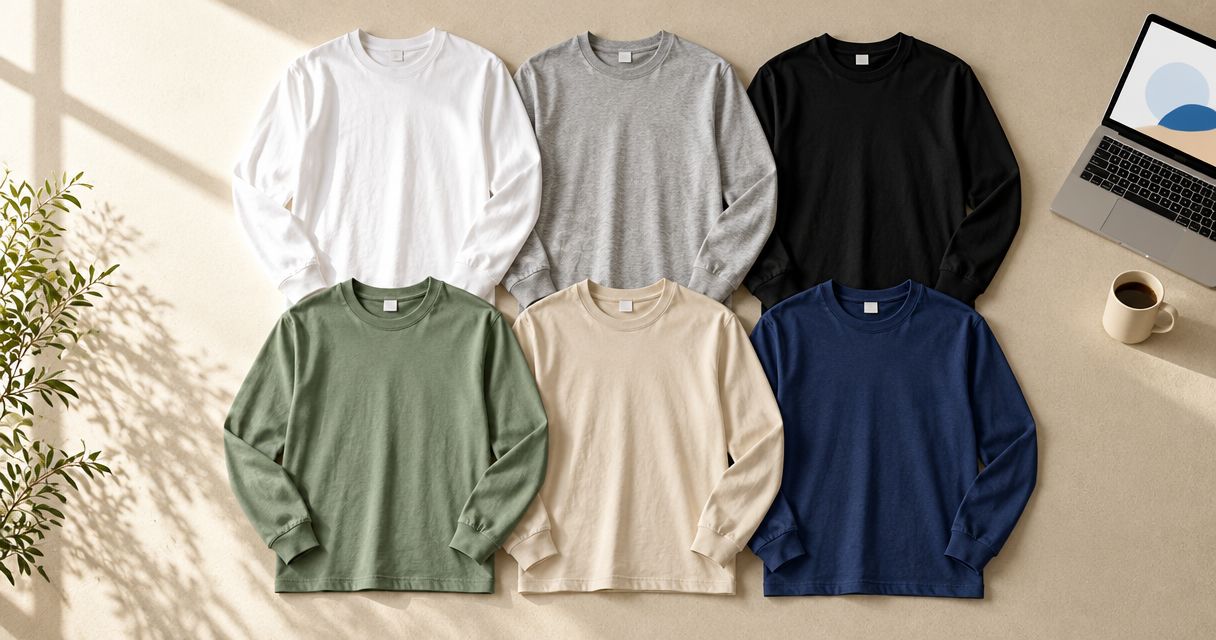
In this guide
Best overall: smooth cotton jersey. Best for structured merch: heavyweight cotton. Best for a simple first order: standard-fit cotton jersey with one print location. This 2026 guide ranks six blank-shirt types by fit, fabric, and artwork needs so you can choose the best blank long sleeve shirts for printing without buying on appearance alone.
TL;DR- The best blank long sleeve shirts for printing start with smooth cotton jersey for everyday custom apparel.
- Choose heavyweight cotton for structure, lightweight cotton for layering, and relaxed fits for roomier silhouettes.
- Sixplanets suits buyers ordering custom long sleeves with no minimum and Frisco pickup.
- Approve the final artwork proof before printing; production takes 5–7 business days, with shipping transit additional.
Why the blank matters before you approve the design
A good graphic cannot fix a shirt you dislike wearing. Choose the garment first, then judge the artwork against its color, proportions, and intended fit.
Sixplanets is best for custom long sleeve buyers who want no minimum order and free Frisco pickup. You can order just one, use premium blanks, and get help with artwork or a larger project. Start with Sixplanets when you are ready to turn the garment brief into a paid custom-apparel order.
For a 2026 band release, staff order, or school event, treat the blank and proof as separate decisions. A design preview helps you assess the concept; final artwork proof approval comes before printing.
What makes the best blank long sleeve shirts for printing?
Use these criteria before comparing blank types:
- Print surface: Favor an even surface where fine artwork needs clear edges. Ask about compatibility with the exact fabric and color.
- Fit: Check the garment measurements, not just the size name. Standard, relaxed, and fitted cuts solve different problems.
- Fabric weight: Choose the feel you want on the body. Heavier fabric gives more structure; lighter fabric suits layering.
- Artwork placement: Plan the design around seams, cuffs, and the usable print area. Confirm each requested location before ordering.
- Wear situation: A creator drop, indoor staff shirt, and outdoor event shirt need different garment briefs.
- Proof clarity: Confirm the garment, artwork version, placement, and order details before approval.
These rankings describe buying briefs, not interchangeable specifications. A relaxed-fit shirt can also be heavyweight; decide which requirement matters most before narrowing the choice.
Best long sleeve blanks at a glance
| Rank and blank type | Best for | Standout characteristic | Key limitation |
|---|---|---|---|
| 1. Smooth cotton jersey | Everyday custom apparel | Straightforward starting point for a printed long sleeve | Cotton alone does not define softness or fit |
| 2. Heavyweight cotton | Structured band and creator merch | More substantial fabric feel | Less suited to light layering |
| 3. Lightweight cotton | Indoor wear and layering | Less bulk under another garment | Less structure for a substantial merch feel |
| 4. Relaxed-fit jersey | Roomier silhouettes | Extra ease through the garment | Artwork proportions need checking on the broader shape |
| 5. Fitted stretch jersey | Close-fitting apparel | Shape that follows the body | Fit and print behavior need particular attention |
| 6. Cotton-polyester blend | Buyers who prefer a blended fabric feel | Alternative hand and drape to all-cotton fabric | Exact blend compatibility needs confirmation |
Do not read the order as a universal quality ladder. The right fitted shirt beats the wrong heavyweight shirt when a close silhouette is the actual requirement.
1. Smooth cotton jersey: best for everyday custom apparel
Smooth cotton jersey is the default brief for a long sleeve with a front graphic, wordmark, or illustration. Start here when you want an everyday shirt rather than a deliberately heavy, oversized, or close-fitting garment.
For a first custom order in 2026, keep the brief clear: a standard silhouette, a fabric feel you like, and artwork sized for that garment. The word cotton does not settle every detail. Construction, finishing, and cut still affect the result.
Smooth cotton jersey pros:
- A practical starting point for general-purpose custom apparel.
- Keeps the garment brief focused when fit is not the main design statement.
- Lets you assess the graphic without intentionally textured fabric competing with it.
Smooth cotton jersey cons:
- Fiber content alone does not establish quality or softness.
- A standard cut will not satisfy someone seeking a distinctly oversized silhouette.
Best for: One-off designs, everyday creator shirts, and straightforward staff apparel.
Verdict: Buy smooth cotton jersey as your default brief; confirm the exact blank before approving the order.
2. Heavyweight cotton: best for structured band and creator merch
Heavyweight cotton makes sense when the shirt's substance is part of the design. Choose this direction because you want structure, not because a heavier garment automatically prints better.
For band merchandise, consider the relationship between the shirt and the graphic. A substantial garment can support a deliberate merch identity, but the artwork still needs its own placement decision. The guide to custom long sleeves for bands and tour merch connects that choice to the wider order.
Heavyweight cotton pros:
- Provides a more substantial feel than a lighter fabric.
- Suits buyers who want the garment itself to feel structured.
- Gives a clear direction for a merch sample before a larger project.
Heavyweight cotton cons:
- Adds bulk when worn under another garment.
- Does not guarantee the fit, softness, or print result you want.
Best for: Bands and creators whose brief prioritizes structure over lightness.
Verdict: Buy heavyweight cotton when substantial fabric is intentional; skip it when easy layering is the priority.
3. Lightweight cotton: best for indoor wear and layering
Lightweight cotton puts less bulk between you and an outer layer. It is a useful direction for an indoor team shirt or a long sleeve intended to sit beneath a jacket.
Choose lightness for the wearing situation, not as a shortcut to another benefit. Fabric weight alone does not establish sun protection, moisture management, or suitability for strenuous work. Keep those requirements separate from the custom-print brief.
Lightweight cotton pros:
- Adds less fabric bulk beneath another layer.
- Fits a brief centered on a light, easy-wearing garment.
- Offers an alternative when heavyweight fabric feels excessive.
Lightweight cotton cons:
- Provides less structure than a heavier shirt.
- Fabric color and opacity deserve attention before ordering.
Best for: Indoor staff apparel, personal designs, and layered outfits.
For a DFW event, decide whether the shirt is the main garment or part of a layered outfit. That distinction is more useful than choosing fabric weight from the event month alone.
Verdict: Buy lightweight cotton for layering; skip it if a substantial garment feel is essential.
4. Relaxed-fit jersey: best for a roomier silhouette
Relaxed-fit jersey makes fit the leading decision. Choose it when you want more room through the garment rather than simply a larger version of a standard cut.
Check body width, length, and sleeve measurements together. Moving up a size changes several dimensions at once; it does not necessarily reproduce a relaxed pattern. For a 2026 creator release, settle the intended silhouette before judging the graphic's scale.
Relaxed-fit jersey pros:
- Gives a clear direction when a roomier shape matters.
- Separates silhouette choice from fabric-weight choice.
- Lets you plan artwork around the garment's actual proportions.
Relaxed-fit jersey cons:
- Size labels alone do not explain the amount of room.
- A graphic needs checking against the wider body rather than copying another shirt's layout.
Best for: Creators and individuals who want an intentionally roomy shirt.
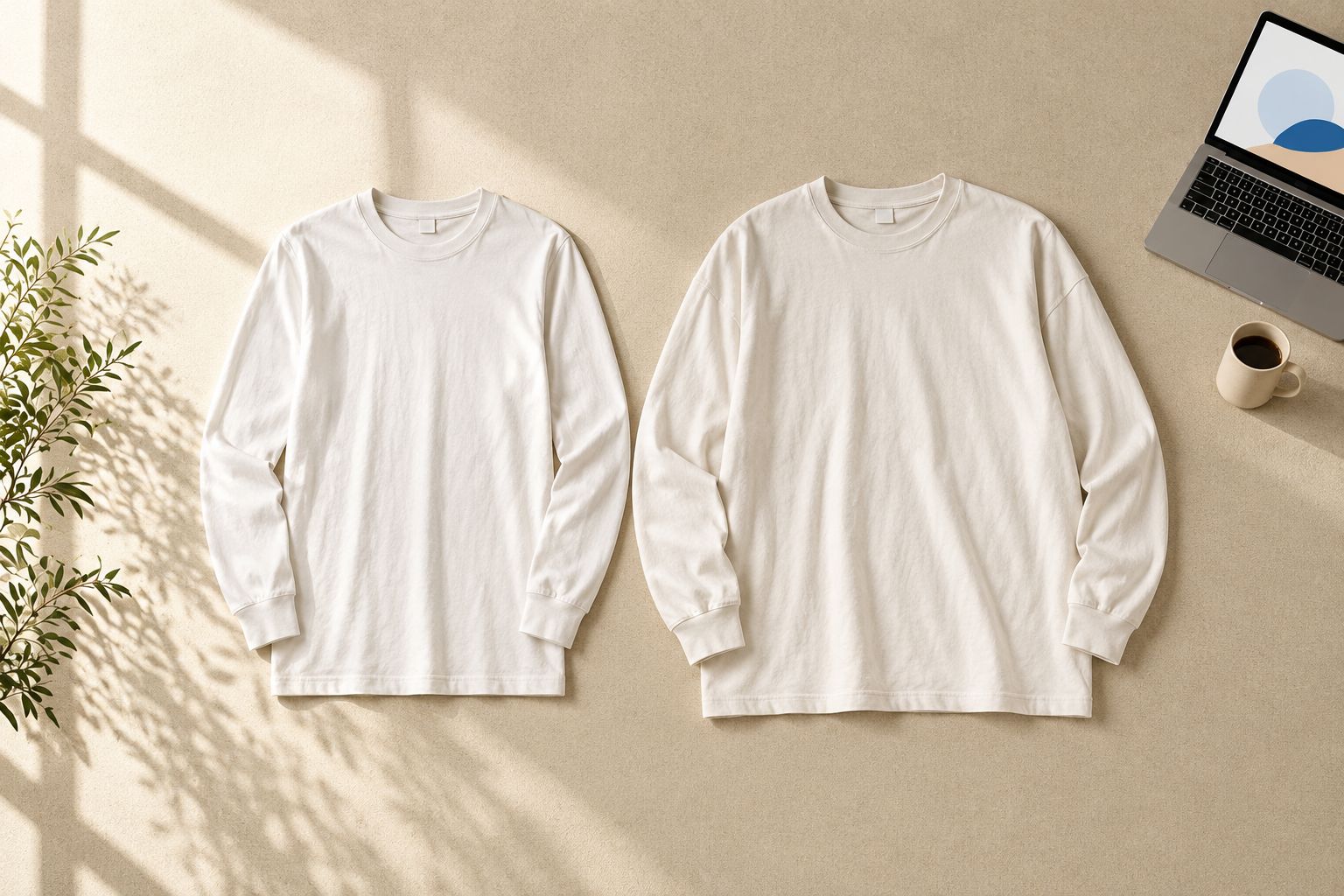
Use the garment measurements to make the decision. A fit description starts the conversation; dimensions make it actionable.
Verdict: Buy relaxed-fit jersey for intentional roominess; do not rely on sizing up alone.
5. Fitted stretch jersey: best for a close-fitting silhouette
Fitted stretch jersey suits a brief where the shirt follows the body. It needs more attention to garment measurements and the relationship between fabric movement and the printed area.
Confirm the exact fabric and printing requirements before committing. Stretch in the garment does not establish how a particular printed design will behave. Keep print suitability and fit approval as separate checks.
Fitted stretch jersey pros:
- Creates a clear alternative to standard and relaxed shapes.
- Suits buyers who specifically want a body-following silhouette.
- Encourages a precise fit brief before artwork approval.
Fitted stretch jersey cons:
- Leaves less room for vague sizing decisions.
- Requires confirmation that the exact garment and artwork suit the printing process.
Best for: Individual orders or coordinated apparel where a close fit is explicitly requested.
For group orders, do not make a fitted cut the default without asking wearers. A shared graphic does not require everyone to prefer the same silhouette.
Verdict: Hold fitted stretch jersey until fit and print compatibility are confirmed.
6. Cotton-polyester blend: best for buyers who prefer blended fabric
Cotton-polyester jersey is an alternative when you prefer the feel or drape of a particular blend. Judge the actual garment rather than treating every blended shirt as equivalent.
The blend ratio, fabric construction, and finishing all matter. Ask whether the chosen fabric and color suit the intended DTF application; do not assume that approval for one blended garment applies to another.
Cotton-polyester blend pros:
- Offers a fabric direction beyond all-cotton shirts.
- Lets you prioritize the hand and drape of a specific garment.
- Can be considered separately from standard, relaxed, or fitted cuts.
Cotton-polyester blend cons:
- The word blend does not establish performance characteristics.
- Exact fabric and color compatibility need checking before printing.
Best for: Buyers who already know they prefer a particular blended fabric feel.
Do not select a blend solely because you expect moisture-wicking, wrinkle resistance, or another performance feature. Those claims need verification for the garment itself.
Verdict: Hold cotton-polyester blends until the exact fabric and print application are confirmed.
How the ranking works
This 2026 ranking prioritizes a clear buying decision: everyday use first, then structure, layering, roominess, close fit, and blended fabric preference. It compares garment briefs rather than claiming a laboratory-tested winner.
The criteria stay the same across all six: print surface, fit, weight, placement, wear situation, and proof clarity. No blank wins every dimension. Choose the one that resolves your main requirement without creating a new problem.
Turn your blank choice into an order
Use this sequence for a Frisco pickup order or a US shipping order:
- Garment brief: State the preferred blank type, color, sizes, and quantities. Say whether structure, lightness, or fit matters most.
- Artwork review: Send the intended design and requested locations. For example, specify 2 print locations as front and back rather than leaving placement open.
- Proof approval: Review the design preview and approve the final artwork proof before printing.
- Production: Allow 5–7 business days after proof approval. Shipping transit is additional; free pickup is in Frisco.
Sixplanets produces locally in Frisco and inspects orders by hand. Ask for help with artwork or larger projects before approving the final proof, not after production begins.
Start your custom long sleeve order
No minimums. Local Frisco production, hand inspection, and free pickup.
Start your orderWhich blank long sleeve should you choose?
Choose smooth cotton jersey if you are undecided. Move to heavyweight cotton for structure, lightweight cotton for layering, or relaxed-fit jersey when roominess is the point. Treat fitted stretch fabric and cotton-polyester blends as choices that need exact garment confirmation.
For your 2026 order, keep the first decision small: choose the garment direction, then resolve artwork and quantity. Sixplanets custom long sleeve orders have no minimum, so ordering one is an option before committing to a larger project.
FAQ
What's the best blank long sleeve shirt for printing?
Smooth cotton jersey is the best default brief for everyday custom long sleeves. Confirm the exact garment, fit, and color before approving artwork.
Is heavyweight cotton better for custom band merch?
Heavyweight cotton is better when a substantial, structured garment is part of the merch brief. It is not automatically better for printing or layering.
Should I size up to get a relaxed long sleeve fit?
Choose by garment measurements rather than sizing up alone. A larger standard shirt does not necessarily have the proportions of a relaxed-fit cut.
Can I order just one custom long sleeve shirt?
Yes. Sixplanets offers custom long sleeves with no minimum order, including individual designs and small merch projects.
How long does custom long sleeve production take?
Production takes 5–7 business days after final artwork proof approval. Shipping transit is additional, and free pickup is in Frisco.
Can I use a cotton-polyester blend for DTF printing?
Confirm compatibility for the exact blend, garment color, and artwork before ordering. Approval for one blended fabric does not establish suitability for every blend.
Do I approve the artwork before my shirts are printed?
Yes. A design preview and final artwork proof approval come before printing. Check the artwork version, garment details, and placement before approving.
One last thing
Write the garment brief before sending the graphic: intended wearer, preferred fit, fabric feel, color, sizes, and requested print locations. That short description gives the artwork a real destination. Choose the shirt you want to wear, then make the design belong on it.